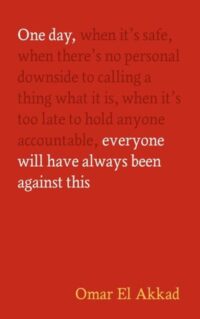
This book isn’t analytically perfect, nor unique in its critique of western liberalism and imperialism. I believe that wasn’t the point, anyway.
Omar’s book is remarkable because it uses language as a mirror to reveal the duplicity of power. He points to the heart of business as usual that fuels life as usual. He connects the personal to powerful forces that govern our lives. My reflections are also connected to some long-standing preoccupations—social change, professional ethics, and agency.
“It has been, for as long as I can remember, the memory that anchors my overarching view of political malice: an ephemeral relationship with both law and principle. Rules, conventions, morals, reality itself: all exist so long as their existence is convenient to the preservation of power. Otherwise, they, like all else, are expendable.”
Colonialism destroyed peoples, places, cultures for a civilisational form that made imperial living the new normal. This access was limited to the civilised, those deemed more human than the rest. They enjoyed a social contract with rights and liberties. Progress was here, but not for everyone and everywhere, and not in the same form. Over time, with struggles for inclusion and the expansion of markets, more people and places got some version of a social contract. Modernity could now be a reality. The promises of this social contract are maintained by an unjust, violent system usually concealed from consciousness and conscience. These promises are precarious. These promises stoke tensions.
But expectations of a normal life look different across the world. For some, it is the promise of wealth, power and abundance. For many others, it is survival with some dignity. Even survival would do, preferably without unbearable oppression. Imperial living may be a commonsensical expectation in many places, but it comes at a high cost to people and places both near and far away.
People want to get on with their lives, normal lives marching onward and upward. And as one goes upward, other people and places become necessarily distant. Give it enough time and distance, people and places become blurry. In the interest of self-interest, distance becomes necessary so other people and places do not trouble us, or make us wonder about our connectedness. Nothing personal, right? You’ve got to do what you’ve got to do.
“We are all governed by chance. We are all subjects of distance.”
This is how structural injustice works. Individuals are part of structures that make them unintentionally act in ways that cause harm to others. But individuals also plays different roles (parent, partner, sibling, teacher, lawyer, worker, friend, philanthropist, etc.) in these structures, and it is in these roles that one can be intentional, where one has agency. And for structural change to happen, all individuals have to push the boundaries of their roles, whether they are affected by injustice or not. Structural transformation needs everyone to push boundaries.
It is no surprise that the few who bravely push boundaries in some roles are persecuted. It is no surprise that students on American campuses are being targeted, students unwilling to look away from the genocide in Gaza, students who force the powerful to confront truths while university leadership capitulates. With knowledge and a raised consciousness, they refuse to trade their edges for a benign well-roundedness. They insist on the humanity of people in far away places, and they insist on it now.
“No, there is no terrible thing coming for you in some distant future, but know that a terrible thing is happening to you now. You are being asked to kill off a part of you that would otherwise scream in opposition to injustice. You are being asked to dismantle the machinery of a functioning conscience. Who cares if diplomatic expediency prefers you shrug away the sight of dismembered children? Who cares if great distance from the bloodstained middle allows obliviousness. Forget pity, forget even the dead if you must, but at least fight against the theft of your soul.”
It is difficult to escape the nature of contemporary modern living: climbing up entails compromises in most fields, no matter how morally tolerable one’s field may be. Beyond the deluge of bullshit jobs, there are also harmful jobs that are obscenely paid, or jobs where the harms are to be ignored. This is the wager that has been normalised: imperial living for ignorance and distance. The demands of the economic system and the nature of everyday living make the wager more palatable. Enough ignorance and distance, so that one day, when the time is convenient, when I will have enough, when I feel secure enough, my family taken care of, I can raise my voice or do some good. Till then, it is either silence, centrism or bothsideism.
“Once far enough removed, everyone will be properly aghast that any of this was allowed to happen. But for now, it’s just so much safer to look away, to keep one’s head down, periodically checking on the balance of polite society to see if it is not too troublesome yet to state what to the conscience was never unclear.”
For the well-rounded, power-climbing striver, ‘centrism’ can be a moral refuge. But this refuge mostly offers vacuous, performative ethics. This refuge has real costs. Imagine the unbearable weight if the striver isn’t single-minded in their pursuits.
What does it mean to take an honest look at one’s job, one’s roles in the bigger picture? And what does it then man to go onward and upward? One might be compelled to bid farewell to the safe harbour of centrism and false balance that greases life as usual.
To imagine walking away from unjust structures is to consider walking to a better place. What would it mean to live decent lives that do not require the annihilation of other peoples and places? And what does that mean for the different roles and identities one takes up in this brief human existence? It may demand an examination and a re-valuation of values.
“This work of leaving, of aiming to challenge power on the field where it maintains the least glaring asymmetry, demands one answer the question: What are you willing to give up to alleviate someone else’s suffering?”
One day, everyone would have had a chance at being on the right side. Today, those chances come in forms big and small, beckoning us not to look away.
“The moral component of history, the most necessary component, is simply a single question, asked over and over again: When it mattered, who sided with justice and who sided with power? What makes moments such as this one so dangerous, so clarifying, is that one way or another everyone is forced to answer.”
Be First to Comment